Why Door Operators Fail in Canadian Winters
I’ve watched building managers blame manufacturers when door operators fail in winter. I’ve heard contractors call it bad luck when systems freeze up in January.
That explanation misses the real cause.
Weather-related door operator failure is a specification problem, not a luck problem. It’s a design and maintenance mismatch between moderate-climate assumptions and Canadian reality.
Contractors routinely install identical door operator systems from Vancouver to Halifax, ignoring the fact that these regions demand entirely different materials, lubricants, and preventive schedules.
This isn’t a manufacturer defect. It’s what happens when factory defaults—designed for moderate climates—are used in environments they were never meant for.
Standard North American specifications break down under Canadian climate conditions. Below is exactly where those failures occur—and what specifications eliminate them.
The Lubricant Problem Nobody Talks About
Most winter failures follow the same predictable pattern, starting with materials that were never selected for extreme cold.
Manufacturers typically ship door operators with lithium grease. It’s inexpensive. It performs adequately in moderate climates.
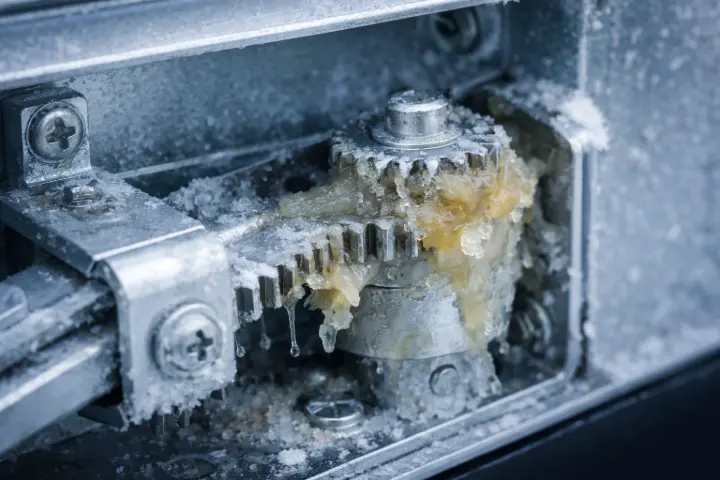
In Canadian winters, lithium grease thickens below −10°C. As viscosity increases, moving components resist motion. The motor compensates by working harder until it overheats or fails.
When temperatures drop to −30°C or −40°C, common across Alberta and the Prairies, standard petroleum-based lubricants become nearly solid. The operator strains against frozen grease until something gives—gears, motors, arms, or control boards.
Silicone-based lubricants rated to −40°C should be specified for Prairie and Northern installations. Lithium grease should never be used in these environments.
Manufacturers rarely make this change by default. Silicone lubricants cost significantly more, and when producing thousands of units, cost decisions favor factory defaults—not regional performance.
The solution is simple but non-negotiable:
- Specify cold-weather lubricants at installation, or
- Replace factory lubricants during scheduled maintenance
There is no workaround.
Metal Brittleness Breaks Components
Cold doesn’t just affect lubricants—it changes the behavior of metal.
As temperatures drop, metal becomes brittle. Operator arms snap. Internal components crack. Mounting points fail.
This isn’t theoretical.
Steel door frames shrink measurably in extreme cold. These dimensional changes introduce stress at operator mounting points and connection arms. Components that tolerated minor misalignment in warmer temperatures now fracture under load.
I see this pattern every winter in high-traffic entrances:
- Shopping center main doors
- Office building lobbies
- Exterior doors exposed to sustained wind and cold
The solution is not hardware that flexes under load. Door operators must be rigidly mounted for safety, control, and long-term reliability.
The correct approach is:
- Proper structural backing within the frame or wall
- Reinforced mounting brackets designed for operator loads
- Adjustable mounting plates that allow precise alignment during installation
- Seals and gaskets designed to tolerate freeze-thaw movement at the frame level
Rigid mounting combined with correct alignment and allowance for expansion in the surrounding structure prevents stress fractures and premature component failure.
Generic installations that ignore cold-induced dimensional change will fail.
Regional Climate Zones Demand Different Specifications
Canada does not have a single climate. Specifications must reflect that.
Halifax does not face the same conditions as Calgary.
Vancouver’s challenges are not Saskatchewan’s challenges.
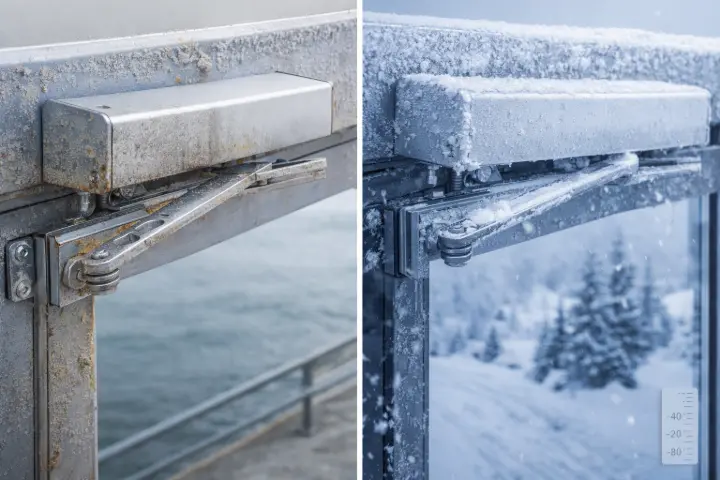
Coastal installations contend with salt air, which can affect structures up to 50 miles inland. In these environments:
- Standard steel corrodes rapidly
- Powder-coated aluminum degrades prematurely
Stainless steel components and conformal coatings should be specified in coastal regions.
Prairie installations face a different threat:
- −40°C winters
- +30°C summers
- Extreme expansion and contraction cycles
These cycles stress:
- Seals
- Mounting points
- Electronic components
One universal specification across Canada will fail.
Material selection must be driven by regional climate data, including:
- Temperature ranges
- Humidity levels
- Freeze-thaw frequency
This isn’t an upgrade. It’s a requirement.
Maintenance Timing Matters More Than Frequency
Annual maintenance schedules miss the most critical windows.
Door operators should be inspected and serviced:
- Before the first hard freeze
- After spring thaw
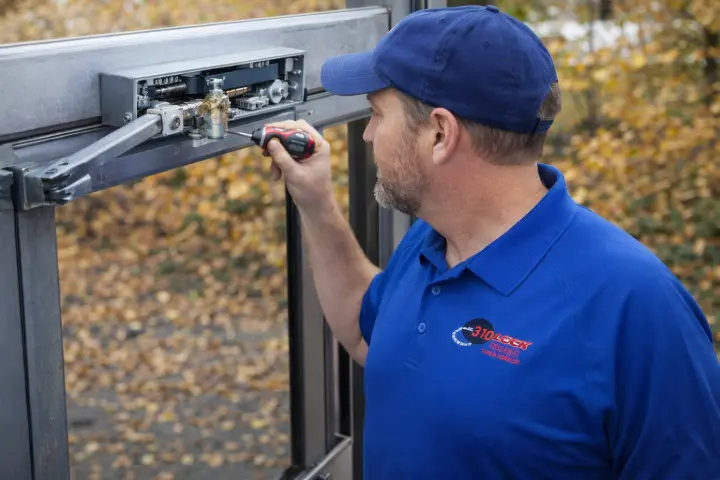
In most Canadian regions, the ideal window is mid-October to early November, when temperatures remain above 10°C long enough for proper lubricant application and coverage.
These operators cost thousands of dollars. When failures cascade through connected systems, replacement often exceeds repair costs.
Property managers already juggle fire inspections, snow removal, waste management, and dozens of competing priorities. Door maintenance often sits somewhere in the middle of that list.
The managers who understand winter failure patterns prioritize high-risk doors:
- Main shopping center entrances
- Exterior doors exposed to wind across parking lots
- High-use accessibility doors that must function reliably
The managers who don’t wait until something breaks—then pay three to five times more to fix problems that seasonal maintenance would have prevented.
The Entire Door System Fails Together
You cannot maintain just the operator.
Every component of the door opening matters.
- Weather stripping: A single loose section creates resistance. The operator compensates. Wear accelerates.
- Thresholds: Snow and ice buildup prevents proper closing. Motors strain. Failures follow.
- Hinges and pivots: Misalignment forces the operator to overcome friction. Lifespan shortens.
- Latching mechanisms: If the latch sticks or freezes, the operator works against a locked condition. Something breaks.
Maintenance means inspecting the complete door opening, not just lubricating the operator motor.
What This Means for Your Installations
- Specify materials using regional climate data, not generic manufacturer defaults
- Replace factory lubricants with cold-weather alternatives rated to your minimum temperatures
- Schedule maintenance around seasonal transitions, not arbitrary quarterly intervals
- Inspect the entire door system, not just the operator
- Prioritize high-traffic exterior entrances with direct weather exposure
The door operators that survive Canadian winters are not better products.
They are properly specified systems, built with climate-appropriate materials and maintained with seasonal intent.
Install the right components.
Maintain them at the right times.
The operators will work.
Install generic components on generic schedules.
The operators will fail.
The choice is specification, not luck.